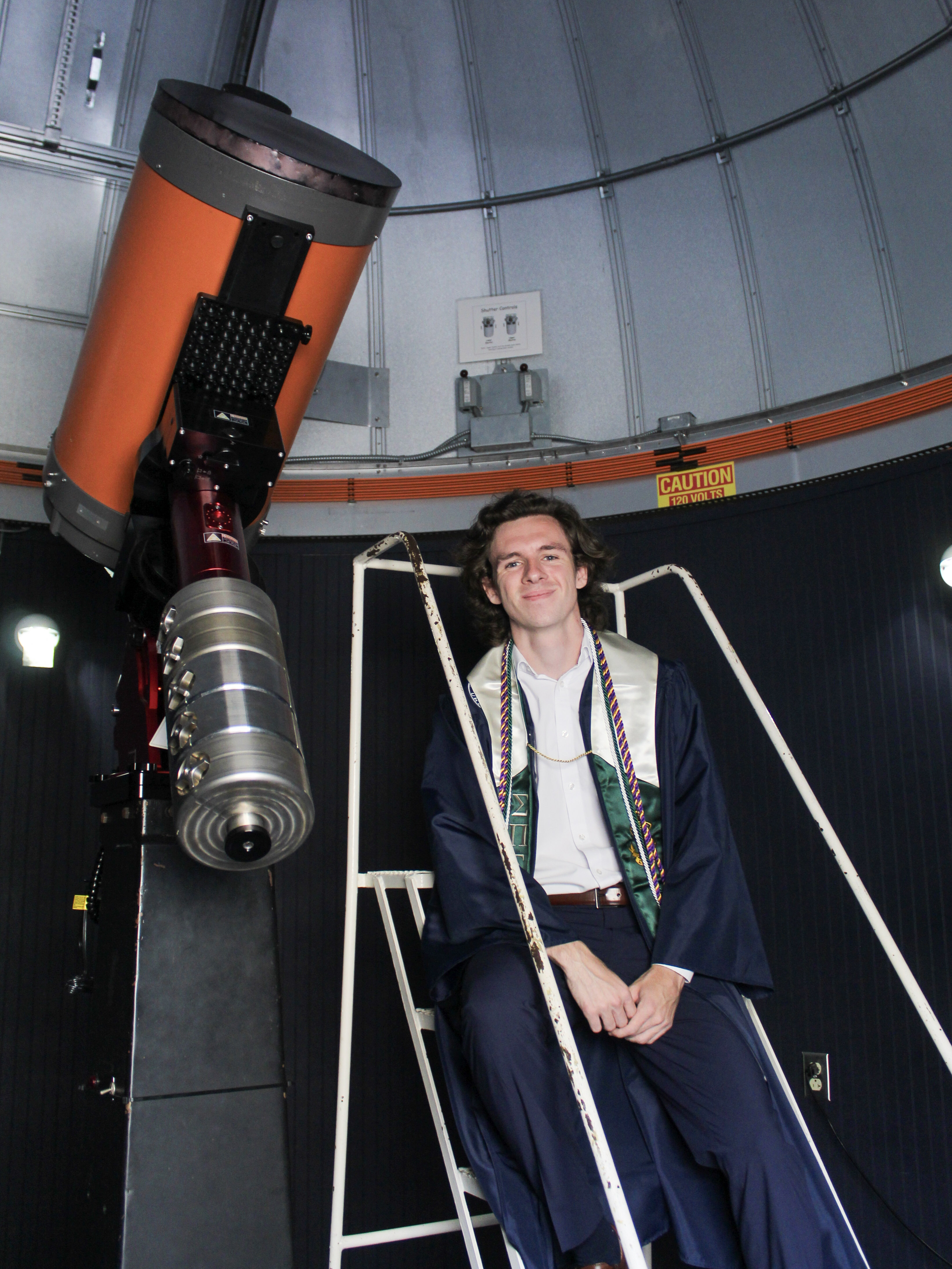
About Me

Hi, I'm Chris, thanks for stopping by!
I'm a PhD student at McGill University supervised by Prof. Daryl Haggard, in the McGill Extreme Gravity and Accretion (MEGA) group, and am a member of the Event Horizon Telescope Collaboration. To learn more about my research actvities, please check out my Research and Past Projects pages on this site!
Education:
I earned my B.S. in Astronomy & Astrophysics from Villanova University, where I first delved into study of supermassive black holes, AGN, and black hole outflows, under the supervision of Dr. Joey Neilsen of the Physics Department. During my studies and a subsequent post-bacc year at Villanova, I also spent time researching red supergiant stars under Dr. Edward Guinan and eclipsing binary stars under Dr. Andrej Prša, respectively.
Why Black Holes? Why M87*?
- little back story blurb here
Research

Broad strokes description of research interests / objectives
- intro supermassive black holes, agn, agn outflows (jets)
- where does the science stand ?
- what are outstanding questions and what are the ones im intersted in ?
Projects
Broadband Multi-wavelength Properties of M87 during the 2018 EHT Campaign including a Very High Energy Flaring Episode
describe my contribution to the project, link paper & press release?
X-ray Variability in the Core and Jet of M87
Through my senior year of my undergraduate studies in 2024, and having begun as early as spring of 2021 in my freshman year, supervised by Dr. Joey Neilsen at Villanova, I studied the X-ray variability in the core and jet of M87. M87 is a massive elliptical galaxy with a several billion solar mass supermassive black hole and was the first black hole to ever be directly imaged by the EHTC. We set out to investigate spectral and X-ray flux variability by modeling and analyzing numerous archival spectra of M87 and the surrounding Virgo Galaxy Cluster, captured by the NuSTAR and Chandra X-ray observatories. Our investigation was motivated by a disparity seen in models of the broader spectral energy distribution (SED) of M87. Historical power-law models of the X-ray band sufficiently recreate the X-ray spectrum of M87, but when incorporated into models of the broader SED, these limit our capability to reproduce the observed levels of higher energy 𝛾-ray emission. After careful analysis of the X-ray data, I was able to show that an X-ray spectral model featuring a broken power-law both provides a better fit and, when included in the SED, presents the SED model with a greater opportunity to include higher levels of 𝛾-ray emission. This is significant because the X-ray band represents a key anchor for SED models, as within this energy range lies detailed insight into the physics of both accretion and ejection around black holes. Accurate models of the observed emission of M87 across the electromagnetic spectrum are vital to establishing the link between accretion activity near the black hole and the mechanisms that dictate the evolution and behavior of M87’s powerful relativistic jet. Considering this significance, I shared my results with the Multi-Wavelength Working Group of the EHTC, and they have since been incorporated into the latest SED analysis of M87, which is detailed in a publication in Astronomy & Astrophysics (see above). Additionally, I presented my findings with a talk at AstroPhilly 2023, a regional symposium of Philadelphia-area undergraduate research, with a poster at the 243rd American Astronomical Society Meeting in January 2024 (view the poster here!), and I am preparing a peer-reviewed publication on this topic for submission to the Astrophysical Journal.
Calibrating the Binary Star Population through Stellar Population Synthesis
project description here
view the poster here!)
Contact